
The Activism Within Our Art
Updated: Jan 26
How Dr. King demonstrated the power of Arts Activism.

“...When I reach out my hand, will you take it, Or cut it off and leave a nub above?” -- Langston Hughes
In 1956 Langston Hughes penned one of his most famous poems, “Brotherly Love” in direct response to the Montgomery Bus Boycott – an inflection point in our nation’s struggle for Civil Rights. One of the leaders of that boycott, a young and charismatic pastor, would go on to become a revolutionary leader in the movement and one of history’s most popular figures.
Today, Dr. Martin Luther King, Jr. is known more as a myth than a man. Those fearful of a truly just society attempt to rewrite his story to exclude his more progressive views. But make no mistake, Dr. King was an activist. And, like almost every activist before and since – he held a close relationship with the artists of his contemporary era.
In fact, during those early days of the Montgomery Boycott, Dr. King picked up the phone and forged a relationship with one of the world’s great Artist-Activists: Harry Belafonte.

At the time Belafonte was most known for his role alongside Dorothy Dandridge in the 1954 movie musical, Carmen Jones.
But the singer/actor had also just released his groundbreaking album “Calypso” – a record that would later be inducted into the Grammy Hall of Fame and selected for preservation by the Library of Congress. To say that, in 1956, Belafonte was the more famous of the two men is an understatement.
While Dr. King maintained very public friendships with artists like Belafonte and Sidney Poitier, it could be argued that his less visible relationships with more progressive artists like Langston Hughes were equally as impactful.
One of the most prominent faces of the Harlem Renaissance, Hughes was a brilliant poet, playwright, and thought leader. In 1953 he was ordered to testify before congress as part of Sen. Joseph McCarthy’s Red Scare search for communists. This red-baiting put Dr. King in a difficult position.
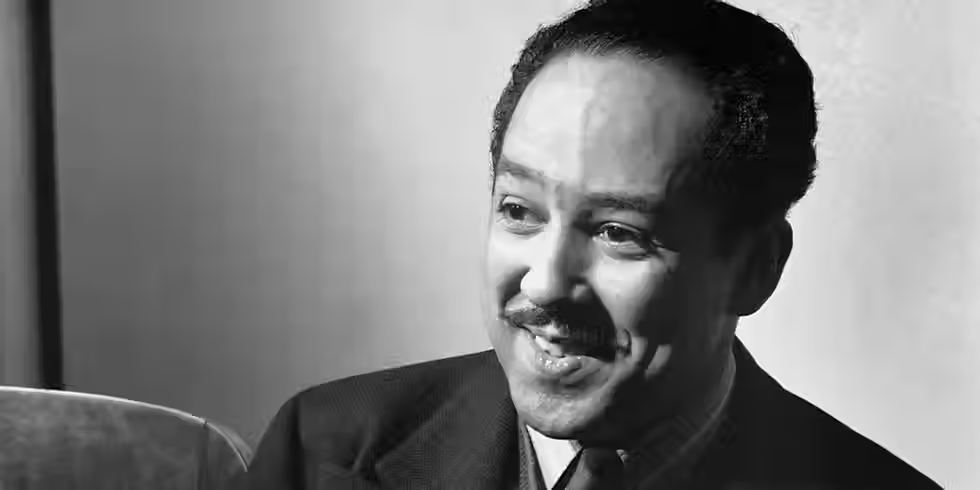
As the public face of the Civil Rights Movement, Dr. King had to negotiate very real tensions between more conservative Black leaders like Adam Clayton Powell and the openly progressive activism of Bayard Rustin. In this balance, we find Dr. King’s very public relationships with artists like Ruby Dee and Ossie Davis, balanced by his more subtle references to the writings of Hughes. (His speeches would often echo imagery from Hughes’ poems “Mother to Son”, “Harlem”, and “Let American be America Again”.)
But Dr. King knew then what we know now – artists are the tip of the spear. Good music, theatre, or dance can entertain – but great art will inspire change and hope. A good play can provide momentary escape, while a truly transcendent work invites an audience to dream of a world from which no one needs to flee because everyone is recognized and valued for their humanity.

The line between art and activism is thin. It winds and bends with the long arc of the moral universe, but within its tensile strength lies an incredible ability to bind.
The arts bind communities together, creating understanding and empathy across barriers and identities. Artists are now and have always been the tip of the spear – helping to craft societal conceptions and influence the proverbial gestalt.
Today, in 2026, it is easy to feel as though 1956 wasn’t that long ago – to ask the question, “What truly permanent progress have we created, or is progress itself never really a permanence, but something for which we always have to struggle?”
Our present feels more like our past, and it’s easy to wonder about our future.
But in these moments, it is, perhaps, our privilege to be able to look back at Harry Belafonte, Ruby Dee, Ossie Davis, and Nina Simone. Perhaps it is our privilege to have examples of what it can mean to live inside of your art and allow that breath of life to exhale liberation.
Dr. King was not a perfect person – but he was a dreamer. And he refused to allow those dreams to dry up or to be deferred. He leaned on the poets, playwrights, choreographers, curators, singers, and songwriters whose art was truly their activism – asking only that they continue their work.
Asking only that we continue to let out art speak, louder and louder than ever.

