
Michigan Votes Tomorrow, But Are We Voting For Artists?
How Voting Yes on the 2026 Transit Millage Can Rebuild Necessary Arts Infrastructure
Every day, every hour (and sometimes it feels like every minute) cell phones across the state of Michigan are abuzz with text messages and phone calls. Political Candidates, Special Interest Groups, and Political Action Committees bombard our phones with emojis, exclamation points, and the type of hyperbolic character assaults that make us all wish The West Wing wasn't just a TV Show.
"Everyone is stupid in an election year, Charlie."
"No, everyone gets treated like they're stupid in an election year, CJ."
While CJ Craig and Charlie Young aren't walking through that door, every Michigander has the opportunity to go to the polls tomorrow and cast their vote in the state primary election.
Encore Michigan has never endorsed a specific candidate (though that may change in the future), but in this moment, as we all attempt to wade through the cacophony of political noise echoing around us, we did want to draw your attention to one specific piece of legislation as an example of the larger concern we all deal with as members of this arts community.
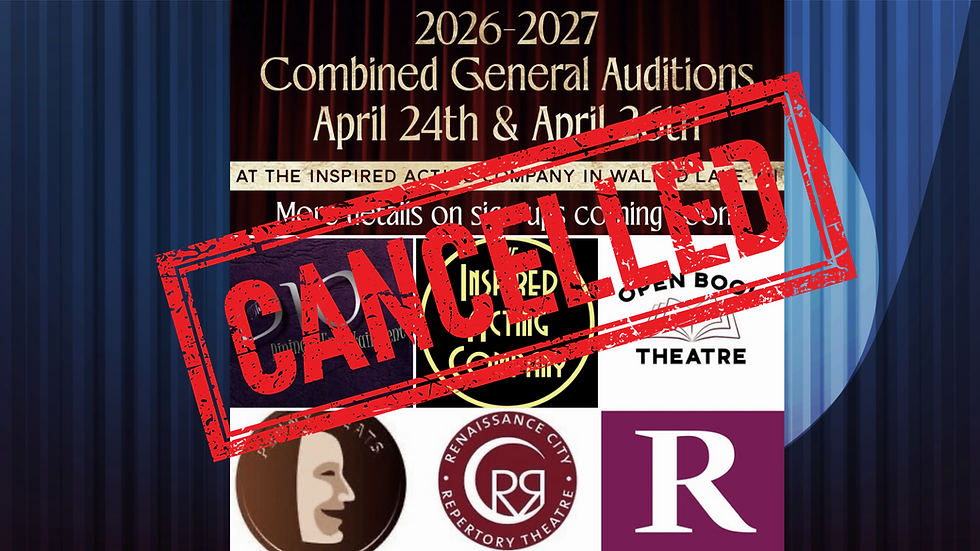
A few months ago, we published a piece about a cancelled audition. Six Michigan theatre companies had organized a unified general audition — the kind of collective infrastructure that lets an actor get in front of multiple artistic directors in a single appointment. It fell apart publicly and painfully, for reasons we documented at length. But underneath the conflict was a structural problem we didn't have room to fully unpack at the time.
So, let’s start to unpack now.
Because Tuesday, August 4th (tomorrow), voters will decide who in our state is entitled to access to transportation
What's on the Ballot
On August 4, all forty-three Wayne County communities will vote as one block on the Wayne County Public Transportation Millage — a proposal to authorize the Wayne County Transit Authority to levy a millage for public transportation services at a rate of 0.9831 mills for ten years, generating an estimated $57.6 million in its first year. Revenue would be distributed to Wayne County, SMART, DDOT, and other community and regional transit providers.
For the twenty-six communities already in the SMART system, this is a renewal. Their millage rate does not increase. For the seventeen communities that have historically opted out — Plymouth, Livonia, Canton, Northville, and others — this is new funding. And for the first time, because of 2025 state legislation signed by Governor Whitmer that ended the opt-out option, the entire county votes together. One majority decides for everyone.
What happens if it passes? Residents get eight new bus routes, five new route extensions, and on-demand flex service across the county over approximately three years.
If it fails: SMART loses its local Wayne County funding. Suburban routes, paratransit, and on-demand service end across the county. Communities that currently have service lose it.
The stakes are not abstract. The Detroit Regional Chamber has endorsed it. Wayne County Executive Warren Evans has endorsed it. The cost to the average homeowner with a $200,000 home: $8 a month.

The Geography of Access
Michigan has 221 registered nonprofit theatre organizations. That is not a small number. It is, in fact, a meaningful number — proof of a creative community that has persisted and built something real in the face of chronic underinvestment.
But understanding what those 221 organizations mean in practice requires understanding the land they are scattered across. Michigan is not a compact metro. It is a state of 56,539 square miles, two peninsulas, and five or six distinct regional theatre ecosystems that have very little structural connection to one another.
Metro Detroit holds roughly 80 of those 221 theatres — about 36 percent of the state total. Grand Rapids and Kent County account for roughly 24 more. Ann Arbor and Washtenaw County add approximately 22. Lansing and the mid-Michigan corridor have a working cluster of their own, anchored by the Wharton Center for Performing Arts — one of Michigan's largest presenting venues — alongside companies like Riverwalk Theatre, Williamston Theatre, and Peppermint Creek. Flint is home to the Flint Repertory Theatre, a professional company operating in the heart of a city that has absorbed decades of economic abandonment and still chooses to make art. Up the thumb of the Lower Peninsula — in St. Clair, Marine City, Port Huron, and the surrounding Blue Water communities — ThumbCoast Theaters operates three stages along the St. Clair River, producing Broadway-style work with 25,000 patrons a year and no fanfare whatsoever from the state's arts establishment. And three hundred miles north of Detroit, tucked between two lakes in the woods of Benzie County, Interlochen Center for the Arts draws students and audiences from around the world for its Arts Academy, its summer festival, and the kind of pre-professional theatre training that the rest of Michigan's institutions can barely approximate.
These are not satellite locations of a central industry. They are independent ecosystems. And between them lie extraordinary distances.

There is no intercity rail connecting any of these markets. Getting from Detroit to Grand Rapids by bus takes between three and five hours, requires a connection in Kalamazoo, and runs infrequent service with no late-night return options. Getting from Detroit to Interlochen without a car is not a realistic option at all.
This is the state's arts infrastructure. All of it. Spread across a geography that treats distance as a given and transit as an afterthought.
The Working Actor's Mileage Problem
Let's make this concrete. Let's talk about an actor we'll call Desiree.
Desiree is a working professional Equity actor in Michigan. She holds her AEA card (Actor's Equity Association), she's built her résumé at union houses across the state. She is, in the parlance of the industry, a "working actor," which is the hardest thing in American theatre to actually be. She knows that union work is how you sustain a career: the guaranteed weekly minimum, the pension contributions, the health insurance that kicks in once you hit enough weeks in a benefit year. An Equity contract isn't just a paycheck. It's the infrastructure that makes this livelihood possible rather than provisional.
To keep that infrastructure intact, she has to work. And to work in Michigan, she has to travel.
This is what her season looks like:
She opens the fall at Farmers Alley Theatre in Kalamazoo — Southwest Michigan's only year-round professional Equity house, 140 miles from Detroit, SPT contract, weekly minimum around $435.
She drives to Flint for her second show at Flint Repertory Theatre, 70 miles northeast of Detroit, another union contract, another week closer to her health insurance threshold.
Third show: Detroit Public Theatre, AEA SPT, $575 weekly minimum, finally back in the city.
For the summer she heads to Williamston, a small town 90 miles northwest of Detroit, for a production at Williamston Theatre — AEA SPT, one of the most respected small professional theatres in the state.
If a guest artist slot opens at Theatre Nova in Ann Arbor, she takes it. Every week counts.
So, let's run the mileage.
Detroit to Kalamazoo: 145 miles. Kalamazoo to Flint: 130 miles. Flint to Detroit: 70 miles. Detroit to Williamston: 90 miles. Williamston to Ann Arbor (Theatre Nova): 55 miles. Ann Arbor back to Detroit: 45 miles.
That's roughly 535 miles across a working season. And that’s just the trips between contracts, before you add daily commutes to rehearsal, callbacks, and general auditions. On a good year, Desiree strings together enough weeks to qualify for health coverage through Actors' Equity. On a hard year, she doesn't. And every year, she drives.
She needs a car. It's not an option It's a requirement. Which means Desiree needs insurance.
Michigan ranks among the top five most expensive states in the country for auto insurance, with average full-coverage premiums running $3,000 to $3,700 per year — compared to $1,238 to $2,316 in Illinois — and Detroit specifically sits at roughly $289 per month, more than double what drivers pay in most Ann Arbor zip codes. That difference doesn't just add up over time. For a working artist trying to string together enough Equity weeks to qualify for health insurance, it's money that determines whether the math works at all.
All of this falls hardest on the people with the least. And in Michigan's arts ecosystem, those people are disproportionately Black.
Detroit is 75 percent Black. Flint is 57 percent Black. Lansing is 26 percent Black. These are not background details. They are the context in which Michigan's theatre ecosystem operates.
When we reported on the cancelled unified auditions earlier this year, multiple sources independently noted extremely low Black actor turnout at past suburban general auditions. That is not coincidence. That is infrastructure operating exactly as designed — not as a conspiracy, but as a system of compounding disadvantages that nobody bothered to redesign.
Eighty-six percent of DDOT ridership is Black, according to the City of Detroit's own Title VI survey data. That number does not exist in isolation. It exists in a region where transit has been systematically defunded, geographically fragmented, and politically opted out of by communities that understood — even if they never said so — exactly what they were opting out of.
30 Miles and No Way Home
Meadow Brook Theatre sits in Rochester Hills. Tipping Point Theatre is in Northville. Both are significant producing companies in Southeast Michigan. Both are, for a large portion of the region's working artists, effectively unreachable without a car.
Route 492 — Meadow Brook's first SMART bus connection in 30 years — launched in April 2024. It runs until 10 p.m. with no Sunday service. A 7:30 curtain means you cannot get home by bus. Tipping Point has no SMART service at all. Northville is one of seventeen Wayne County municipalities that have opted out of SMART funding — a choice that is not incidental, and is not neutral.
Think about what that means in practice. If you are a working actor in without a car a substantial portion of the region's professional employment is not inaccessible to you. Not because the companies don't want you. But because the infrastructure doesn't include you.
Matt Tomich of The Dio, a theatre company in Pinckney, MI, spoke with us during our audition reporting. He said something that still resonates:
"It's always good to see actors that normally wouldn't drive out to us."
That sentence carries more than he may have intended. "Normally wouldn't drive" is doing real work there. For many actors in this region, the barrier isn't inclination. It's the absence of a bus.
Who Rides. Who Doesn't. Why It Matters.
The transit problem is real. It is also only part of the problem.
Markets that work have two structural pillars Michigan does not. Dense public transit is the first. The second is a coordinating body — an organization with the institutional capacity to run unified auditions, advocate for the sector, and connect companies to each other and to their communities.

The Black Leadership Advisory Council — BLAC — is a body appointed by Governor Whitmer to advise her administration on policies affecting Black families and communities across Michigan. Its Arts & Culture Committee is chaired by Gary Anderson, who also serves as Producing Artistic Director of Plowshares Theatre Company in Detroit.
BLAC has made formal recommendations to the Governor arguing that access to culture is a condition of human dignity, and that decades of restricted, project-by-project arts funding have produced documentable, concentrated harm.
We'll go deeper on BLAC's recommendations — and on the broader question of artistic governing bodies and political power in Michigan — in a future piece. But here is what matters right now: BLAC's work is proof that when artists and advocates exert organized influence over the people making policy decisions, things can move. The roadmap exists because someone made the case, repeatedly, in rooms where those decisions get made.
What the transit data, the insurance data, and the demographic map of Michigan theatre all confirm is that the barriers artists face are structural — built from the accumulation of choices that nobody was ever required to revisit, and sustained by the political disengagement of the people most affected. The artists with the least access have also had the least political power.
Why You Should Vote Yes
None of the larger structural fixes are on Tuesday's ballot. But Tuesday could be the beginning or the end of something significant. A region that will not invest $8 a month to connect its residents to each other is not a region that will invest in the coordinating bodies, the unified auditions, or the arts infrastructure that makes a creative sector function.
The vote on August 4 is not an arts vote. But it is an arts question. It asks: who counts as part of this community? Who gets to participate? Whose access matters?
Michigan's arts community has been asking those same questions for years — in grant applications, in equity statements, and community conversations.
Tomorrow’s vote affects artists across the state – it gives us an opportunity to advocate for our sector and make our voices heard. The vote itself might be cast in Wayne County, but the infrastructure crisis it addresses — the geographic isolation, the absence of a coordinating body, the presence of transit deserts that determine who gets to participate in the arts — that crisis belongs to all of us.
Encore Michigan hasn't traditionally made it a practice to endorse particular political views or candidates. But if you chose to oppose this initiative -- just ask yourself why.
Wayne County residents can learn more about the transit millage at bit.ly/SMARTMovesUs. Polls are open 7 a.m. to 8 p.m. on August 4.


