
The Week After: What Last Tuesday's Election Results Mean for Artists in Michigan
Monday, we asked a question:
"Who gets to participate in the arts? Who gets to have access?"
Tuesday, voters gave us a partial answer.
The Good News Came First
The Wayne County Public Transportation Millage passed — 66 percent in favor.¹ For the first time, all 43 Wayne County communities, including the 17 that historically opted out, voted together and said yes. For the working actors we wrote about Monday — driving 535 miles across a season just to string together enough weeks to qualify for health insurance — this is not a solution. But, it is a start.
Then came a result most might not have immediately connected to our sector. Proposal S — Detroit Public School Community District's operating millage transfer — passed with 80.8 percent of the vote.² Nearly four in five Detroit voters said yes to keeping $112 million a year in the district's operating budget. DPSCD's own campaign materials listed exactly what that money sustains: music and arts, athletics, guidance counselors, mental health services. Tuesday, Detroit voters protected all of it. By a landslide.
Now the Harder Question
The millage results were the "easy part". The harder question is what happens in November, when the candidates who actually have control over funding take office.
To understand the stakes, we need a brief lesson in recent history.

In August 2025, the Republican-led Michigan House passed a budget that completely zeroed out all state arts funding³ — eliminating the entire $12.3 million Michigan Arts and Cultural Council grant program in a single stroke. House Speaker Matt Hall called arts funding "an example of waste" and argued that private donors, not taxpayers, should fund the arts. He was more direct on social media: "We need to stop using tax dollars to fund nonsense programs like barbershop quartets."⁴
The Michigan Economic Development Corporation pushed back, along with artists and organizations across the state, arguing that arts and culture reaches 12 million residents and 4 million children annually while contributing $20.5 billion to the state economy. When the dust settled, Gov. Whitmer signed a final budget into law with $8 million designated for arts and cultural funding. ⁵
But Michigan was already starting from behind. According to the National Assembly of State Arts Agencies’ (NASAA) FY2026 State Arts Agency Revenues Report,⁶ Michigan ranks 24th nationally in per capita arts funding at $1.08 — below the Midwest average of $1.16 (itself well below the national average of $1.88), and a fraction of what Minnesota invests at $7.85 per capita.
Ohio spends roughly twice what Michigan does. Even the Buckeyes are beating us in this category.
Federally, the Republican House proposed eliminating the Assistance for Arts Education program entirely, a potential cut of $36.5 million.⁷ Arts funding is contracting at every level and the coming election this November could decide whether that continues.
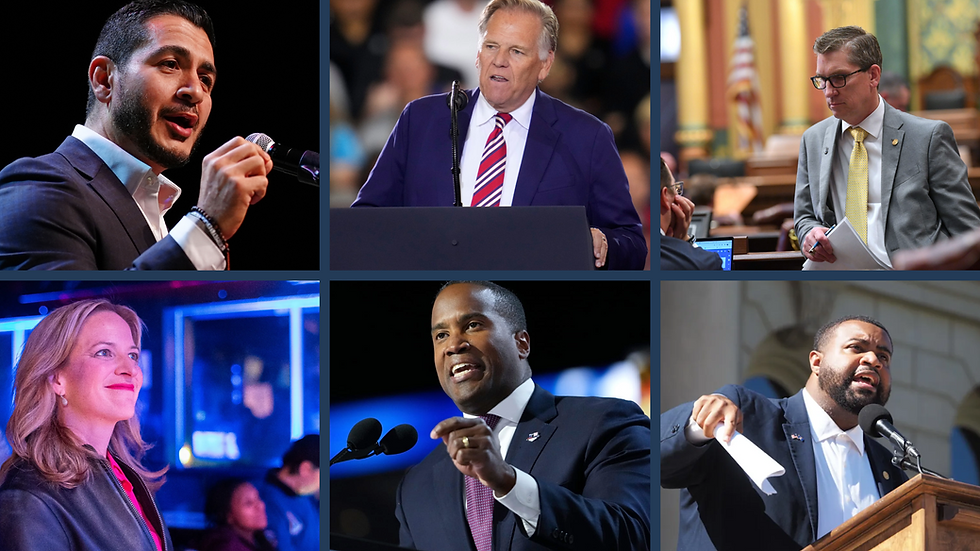
Dr. Abdul El-Sayed won the Democratic Senate primary, defeating Rep. Haley Stevens after being outspent nearly 11-to-1 by outside groups.⁸ He doesn't have an arts platform. But one component of his central argument, Medicare for All, raises a direct question: would universal healthcare reduce artists' dependence on union membership for health coverage?
The obvious answer is yes. Right now, a union actor has to accumulate enough union weeks per quarter to qualify for insurance through AEA (The Actor’s Equity Association). That threshold is why actors drive 535-mile seasons and chain themselves to a handful of AEA-contracted houses. Decouple health coverage from union employment status, and an actor (or, for that matter, a stage manager, lighting designer, carpenter, etc.) can take gigs that most benefit their career - without having to consider whether or not they need to take a gig just to keep their health coverage. It doesn't build the full infrastructure we need. But it removes one of the most punishing structural barriers to doing the work.
Mike Rogers, the Republican senatorial nominee, hasn't addressed arts funding, the NEA, or state grants this cycle. His congressional majority is the one that proposed zeroing out federal arts education funding. The contrast is not subtle.
The Governor's Race Is Where It Gets Local
The governor signs the state budget. That makes the governor's race arguably the most consequential to Michigan artists right now.
Jocelyn Benson (D) won her primary 85–15.⁹ She has proposed a weighted, equitable school funding formula directing more money to districts with the greatest need, a $60,000 minimum starting salary for teachers, and (in her own words) investment in public transit, "perhaps even light rail." None of that is an arts platform. But all of it is a precondition for a sustainable arts ecosystem.
John James (R), in contrast, wants to opt into the federal school voucher mechanism on day one and has built his platform around what he calls "back to basics." He told an audience in Midland: "We are going to focus on academics, not activism."
But artists are activists.
While the arts aren't explicitly attacked in his materials, they are explicitly absent — grouped among the extras a “back-to-basics” framework deprioritizes when budgets tighten. The Republican-led House already cut $2 million from arts grants this cycle. James's platform gives no reason to expect that trajectory reverses.
More Races Worth Watching
In State Senate District 1 — Detroit and Downriver — Democrat Justin Onwenu defeated Abraham Aiyash 58–41. Onwenu is Detroit's former director of entrepreneurship, backed by Mayor Mary Sheffield.

In State Senate District 28 — the MSU corridor covering Clinton, Ingham, and Shiawassee Counties — Dr. Rashida Harrison won a four-way Democratic primary capturing 42 percenta of the vote. Harrison is an MSU professor of African American and African Studies, a union member, a community organizer, and — from 2022 to 2025 — Director of Arts Education and Professional Development at The GhostLight Arts Initiative. Her platform centers equity, campaign finance reform, and investment in social services and education. That matters.
In Michigan's 13th Congressional District — covering Detroit, Grosse Pointe, and Downriver communities — State Rep. Donavan McKinney (D) defeated two-term incumbent Rep. Shri Thanedar 51.9 to 48.1 percent in one of the most closely watched House primaries in the country. McKinney, 34, a democratic socialist backed by Bernie Sanders, the DSA, and members of the Congressional Black Caucus, ran explicitly on Medicare for All, housing, and getting corporate money out of politics. The district is safely Democratic. What his win signals, alongside El-Sayed's Senate victory, is that Detroit's progressive voters are not waiting for permission to demand more — from their healthcare system, from their economy, and, by extension, from the cultural infrastructure that serves them.

Finally, watch Michigan's 30th Senate District this November — West Michigan, Grand Rapids area, currently held by Republican State Sen. Mark Huizenga. Democrat Carol Glanville, a west Michigan legislator, is challenging him in a race Huizenga last won by a third of a percentage point. Democrats currently hold a two-seat majority in the Michigan Senate — the body that has twice been the firewall against House Republican attempts to cut or eliminate arts funding. If Republicans hold this seat and flip others like it, that firewall is threatened. West Michigan is home to a robust and growing arts sector, anchored by institutions like Opera Grand Rapids, the Grand Rapids Art Museum, the Grand Rapids Symphony, and the West Michigan Symphony. Those institutions, and the artists who work in and around them, have a direct stake in who controls the chamber that decides their funding.
What This Actually Means
Supporting artists isn't just about funding the arts. It's about creating an infrastructure — fertile ground for the sector to grow and thrive. Can El-Sayed follow through on his promise of Medicare for All, and will it support the gig workers and artists who don't always work enough to access health care through a union? What does it mean to put public funds into school voucher programs instead of public schools? Can a candidate help control the cost of gas as artists drive from gig to gig? These issues affect all Michiganders — and they affect artists with particular force.
Tuesday was not an arts election. But it told us something.
The transit millage passed because voters said: we want to be connected. Proposal S passed because eight in ten Detroit voters said: keep the music programs, keep the counselors, keep what makes a school worth attending. Those values, expressed at the ballot, give arts advocates some hope upon which we can hang our proverbial hats.
El-Sayed and Benson, if they win in November, don't hand Michigan artists a new infrastructure. But their frameworks open doors that Rogers and James, under their stated platforms, do not. Neither race is decided. Both will be competitive.
And let's be clear about something: being a Democrat doesn't automatically make a candidate an ally of the arts.

Detroit Mayor Mary Sheffield.

Rochelle Riley served as the Director of Detroit's office for Arts, Culture, and Entrepreneurship. She is now the Director of Cultural Affairs for the City of Charleston
Detroit Mayor Mary Sheffield — a Democrat — has yet to put forward a coherent arts policy for the city that is home to more of Michigan's working artists than anywhere else in the state. Detroit ACE (the city's Department of Arts, Culture, and Entrepreneurship) remains without a director, after Sheffield ushered Rochelle Riley out of that position earlier this year. That's a conversation for another article. But it's a reminder that party affiliation is not arts policy, and the arts community cannot afford to treat it as one.
The Michigan arts budget went from $13.5 million to $8 million over two budget cycles — after the arts community spent a year fighting off elimination entirely. Almost nobody noticed.
We have to be louder, and we have to stay loud. November is right around the corner.
Want to Know Where We Got Our Facts? Take a Look!
¹ "Wayne County transit millage passes," Detroit Free Press, August 5, 2026. https://www.freep.com/story/news/local/michigan/detroit/2026/08/05/wayne-county-transit-millage-passes-canton-detroit-livonia/91125863007/
² "Wayne County Michigan primary election results 2026," Detroit Free Press, August 4, 2026. https://www.freep.com/story/news/politics/elections/2026/08/04/wayne-county-michigan-primary-election-results-2026/91160087007/
³ "Michigan gets a new state budget: winners and losers," Bridge Michigan, 2025. https://bridgemi.com/michigan-government/michigan-gets-a-new-state-budget-winners-losers-in-the-81b-deal/
⁴ "Michigan arts programs face $11 million cut in proposed budget," Fox 47 News. https://www.fox47news.com/news/local-news/michigan-arts-programs-face-11-million-cut-in-proposed-budget
⁵ Governor Whitmer press release, FY2027 budget signing, July 3, 2026. https://www.michigan.gov/whitmer/news/press-releases/2026/07/03/whitmer-legislative-leaders-deliver-bipartisan-fy27-budget
⁶ NASAA, State Arts Agency Revenues FY2026. https://artsboard.wisconsin.gov/Documents/FY%2026%20NASAA%20%20State%20Arts%20Agency%20Revenues%20pub.pdf. See also Arts Midwest, Public Funding for the Arts in the Midwest: 2026 by the Numbers. https://artsmidwest.org/resources/research-data/public-funding-for-the-arts-in-the-midwest-2026-by-the-numbers/
⁷ National Association for Music Education, "Federal Budget Update: What Proposed FY2026 Education Cuts Mean for the Arts." https://nafme.org/blog/federal-budget-update-what-proposed-fy-2026-education-cuts-mean-for-the-arts/
⁸ "Abdul El-Sayed wins Michigan's Democratic Senate primary," NBC News, August 4, 2026. https://www.nbcnews.com/politics/2026-election/abdul-el-sayed-wins-michigans-democratic-senate-primary-notching-midwe-rcna589750
⁹ "Benson handily wins Democratic gubernatorial primary," Michigan Advance, August 4, 2026. https://michiganadvance.com/2026/08/04/benson-handily-wins-democratic-gubernatorial-primary-over-swanson/


